Datenbank-Schema - Backoffice & CRM (Phase 2)
PostgreSQL-Datenbankstruktur für WorkmateOS Phase 2
Übersicht
Die Backoffice-Datenbank umfasst zwei Hauptbereiche:
- Core-Tabellen: Grundlegende Entitäten (Mitarbeiter, Abteilungen, Rollen, etc.)
- CRM & Backoffice-Tabellen: Kundenverwaltung, Projekte, Zeiterfassung, Finanzen
📊 Entity Relationship Diagram
Visuelle Darstellung
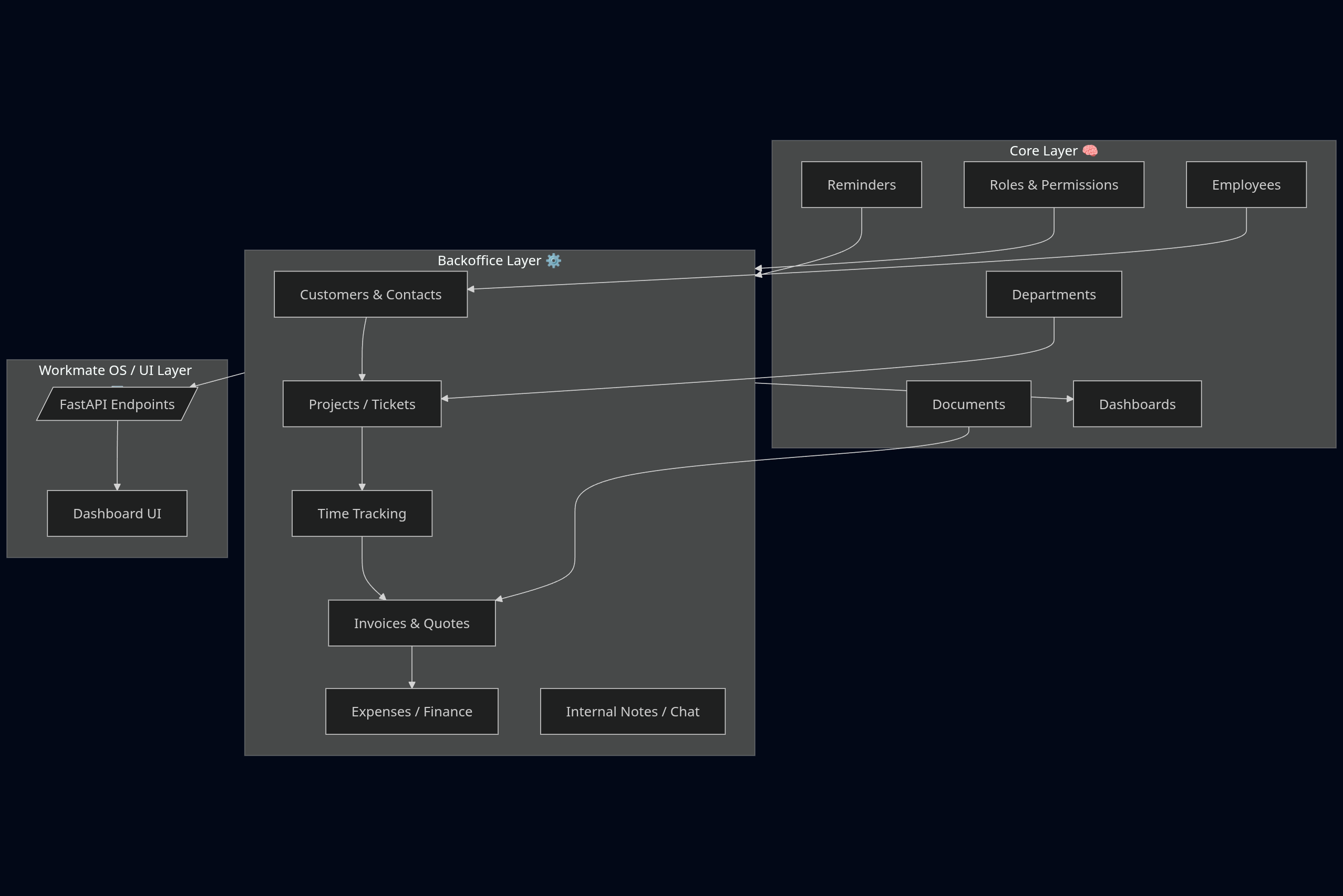
Vollständiges ERD mit allen Tabellen und Beziehungen
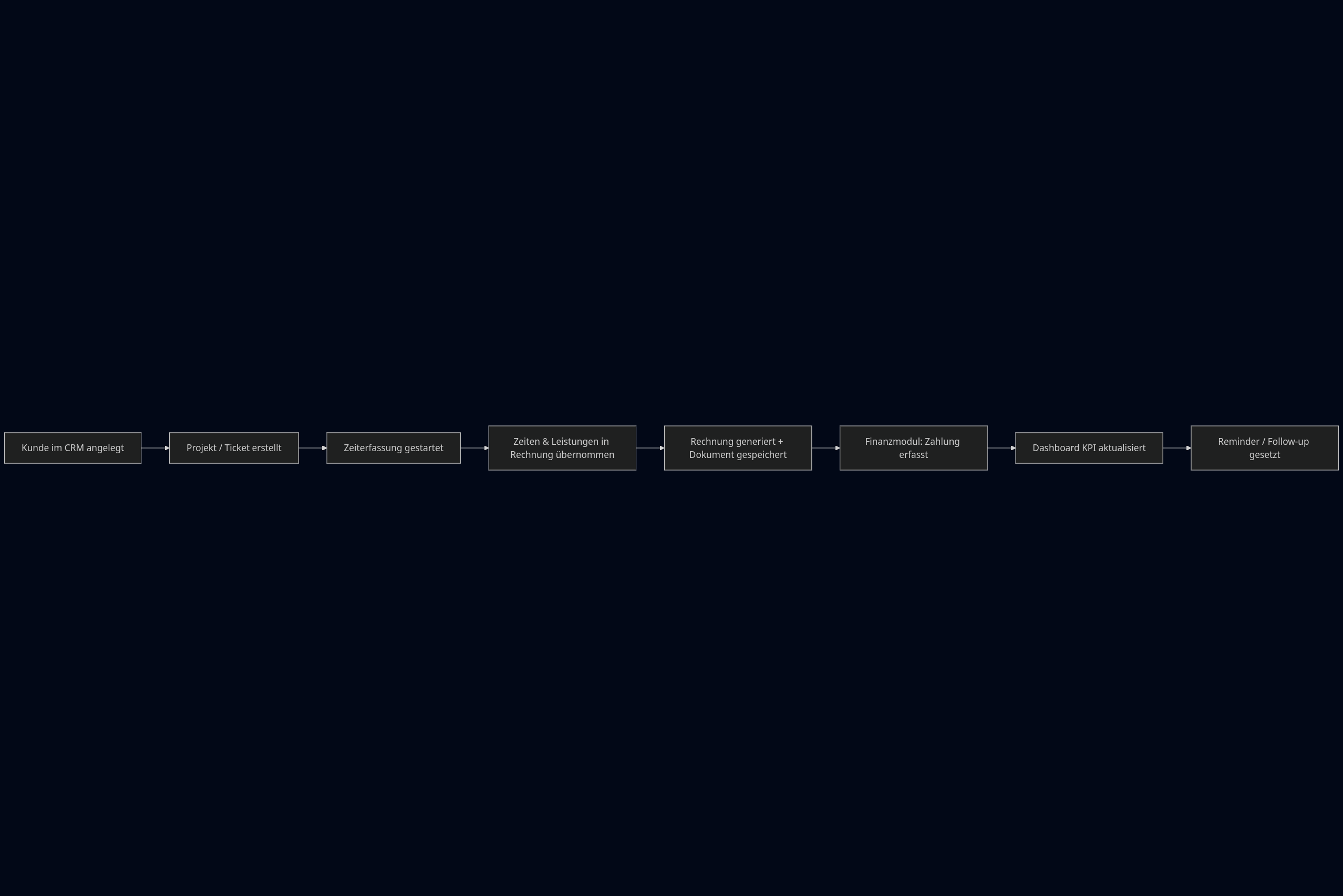
Modul-Architektur und Datenfluss
🗄️ Core-Tabellen
employees (Mitarbeiter)
Beschreibung: Mitarbeiterstammdaten mit Rollen- und Abteilungszuordnung
| Spalte | Typ | Beschreibung |
|---|---|---|
id | uuid | Primary Key |
firstname | varchar | Vorname |
lastname | varchar | Nachname |
email | varchar | E-Mail-Adresse |
role_id | uuid | Foreign Key → roles.id |
department_id | uuid | Foreign Key → departments.id |
created_at | timestamp | Erstellungsdatum |
updated_at | timestamp | Letzte Änderung |
Relationen:
role_id→roles.id(Many-to-One)department_id→departments.id(Many-to-One)- Rückverweise:
time_entries,chat_messages,dashboards,reminders,documents
departments (Abteilungen)
Beschreibung: Organisationsstruktur mit Abteilungen und Managern
| Spalte | Typ | Beschreibung |
|---|---|---|
id | uuid | Primary Key |
name | varchar | Abteilungsname |
manager_id | uuid | Foreign Key → employees.id |
created_at | timestamp | Erstellungsdatum |
updated_at | timestamp | Letzte Änderung |
Relationen:
manager_id→employees.id(Many-to-One)- Rückverweise:
employees,projects
roles (Rollen & Berechtigungen)
Beschreibung: Rollen mit JSON-basiertem Berechtigungssystem
| Spalte | Typ | Beschreibung |
|---|---|---|
id | uuid | Primary Key |
name | varchar | Rollenname (z.B. "Admin", "Manager") |
permissions | jsonb | Berechtigungen als JSON |
created_at | timestamp | Erstellungsdatum |
updated_at | timestamp | Letzte Änderung |
Beispiel permissions JSON:
{
  "crm": ["read", "write", "delete"],
  "projects": ["read", "write"],
  "invoices": ["read"],
  "admin_panel": ["access"]
}
Relationen:
- Rückverweise:
employees
documents (Dokumentenverwaltung)
Beschreibung: Zentrale Dokumentenverwaltung mit polymorpher Verknüpfung
| Spalte | Typ | Beschreibung |
|---|---|---|
id | uuid | Primary Key |
title | varchar | Dokumenttitel |
file_path | text | Dateipfad auf Server |
type | varchar | Dateityp (pdf, docx, xlsx, etc.) |
category | varchar | Kategorie (contract, invoice, report) |
owner_id | uuid | Foreign Key → employees.id |
linked_module | varchar | Modulname (customer, project, invoice) |
linked_id | uuid | ID des verknüpften Objekts |
checksum | varchar | SHA256-Prüfsumme |
is_confidential | boolean | Vertraulich? |
created_at | timestamp | Erstellungsdatum |
updated_at | timestamp | Letzte Änderung |
Polymorphe Verknüpfung:
linked_module+linked_idermöglichen flexible Zuordnung zu beliebigen Entities- Beispiel:
linked_module = "customer",linked_id = "123-456-789"→ Dokument gehört zu Kunde mit ID 123-456-789
Relationen:
owner_id→employees.id(Many-to-One)
reminders (Erinnerungen & Aufgaben)
Beschreibung: Aufgabenverwaltung mit Fälligkeitsdatum und Priorität
| Spalte | Typ | Beschreibung |
|---|---|---|
id | uuid | Primary Key |
title | varchar | Aufgabentitel |
due_date | date | Fälligkeitsdatum |
priority | varchar | Priorität (low, medium, high) |
linked_to | varchar | Verknüpfung (customer, project, invoice) |
owner_id | uuid | Foreign Key → employees.id |
is_done | boolean | Erledigt? |
created_at | timestamp | Erstellungsdatum |
updated_at | timestamp | Letzte Änderung |
Relationen:
owner_id→employees.id(Many-to-One)
dashboards (Benutzer-Dashboards)
Beschreibung: Personalisierte Dashboard-Layouts pro Benutzer
| Spalte | Typ | Beschreibung |
|---|---|---|
id | uuid | Primary Key |
user_id | uuid | Foreign Key → employees.id |
layout_json | jsonb | Widget-Layout als JSON |
theme | varchar | Theme (dark, light) |
created_at | timestamp | Erstellungsdatum |
updated_at | timestamp | Letzte Änderung |
Beispiel layout_json:
{
  "widgets": [
    {"id": "crm-stats", "x": 0, "y": 0, "w": 4, "h": 2},
    {"id": "recent-customers", "x": 4, "y": 0, "w": 4, "h": 2},
    {"id": "project-timeline", "x": 0, "y": 2, "w": 8, "h": 3}
  ]
}
Relationen:
user_id→employees.id(Many-to-One)
🏢 CRM & Backoffice-Tabellen
customers (Kunden)
Beschreibung: Kundenstammdaten für CRM
| Spalte | Typ | Beschreibung |
|---|---|---|
id | uuid | Primary Key |
name | varchar | Firmenname / Name |
type | varchar | Kundentyp (B2B, B2C) |
email | varchar | E-Mail-Adresse |
phone | varchar | Telefonnummer |
tax_id | varchar | Steuernummer / USt-IdNr. |
address | text | Vollständige Adresse |
created_at | timestamp | Erstellungsdatum |
updated_at | timestamp | Letzte Änderung |
Relationen:
- Rückverweise:
contacts,projects,invoices
contacts (Kontaktpersonen)
Beschreibung: Ansprechpartner bei Kunden
| Spalte | Typ | Beschreibung |
|---|---|---|
id | uuid | Primary Key |
customer_id | uuid | Foreign Key → customers.id |
firstname | varchar | Vorname |
lastname | varchar | Nachname |
email | varchar | E-Mail-Adresse |
phone | varchar | Telefonnummer |
position | varchar | Position (z.B. "Geschäftsführer") |
created_at | timestamp | Erstellungsdatum |
updated_at | timestamp | Letzte Änderung |
Relationen:
customer_id→customers.id(Many-to-One)
projects (Projekte)
Beschreibung: Kundenprojekte mit Status und Zeitrahmen
| Spalte | Typ | Beschreibung |
|---|---|---|
id | uuid | Primary Key |
customer_id | uuid | Foreign Key → customers.id |
department_id | uuid | Foreign Key → departments.id |
title | varchar | Projekttitel |
status | varchar | Status (planned, in_progress, completed, cancelled) |
start_date | date | Startdatum |
end_date | date | Enddatum |
description | text | Projektbeschreibung |
created_at | timestamp | Erstellungsdatum |
updated_at | timestamp | Letzte Änderung |
Relationen:
customer_id→customers.id(Many-to-One)department_id→departments.id(Many-to-One)- Rückverweise:
time_entries,invoices,expenses,chat_messages
time_entries (Zeiterfassung)
Beschreibung: Arbeitszeiterfassung pro Mitarbeiter und Projekt
| Spalte | Typ | Beschreibung |
|---|---|---|
id | uuid | Primary Key |
employee_id | uuid | Foreign Key → employees.id |
project_id | uuid | Foreign Key → projects.id |
start_time | timestamp | Startzeit |
end_time | timestamp | Endzeit (NULL = läuft noch) |
duration | interval | Dauer (PostgreSQL interval) |
note | text | Notiz zur Tätigkeit |
created_at | timestamp | Erstellungsdatum |
updated_at | timestamp | Letzte Änderung |
Besonderheiten:
durationwird automatisch ausend_time - start_timeberechnetend_time = NULLbedeutet "Timer läuft noch"
Relationen:
employee_id→employees.id(Many-to-One)project_id→projects.id(Many-to-One)
invoices (Rechnungen)
Beschreibung: Kundenrechnungen mit PDF-Export
| Spalte | Typ | Beschreibung |
|---|---|---|
id | uuid | Primary Key |
customer_id | uuid | Foreign Key → customers.id |
project_id | uuid | Foreign Key → projects.id (optional) |
total | numeric | Gesamtbetrag |
status | varchar | Status (draft, sent, paid, overdue) |
due_date | date | Fälligkeitsdatum |
issued_date | date | Rechnungsdatum |
pdf_path | text | Pfad zur PDF-Datei |
created_at | timestamp | Erstellungsdatum |
updated_at | timestamp | Letzte Änderung |
Relationen:
customer_id→customers.id(Many-to-One)project_id→projects.id(Many-to-One, optional)- Rückverweise:
payments,expenses
payments (Zahlungen)
Beschreibung: Zahlungseingänge für Rechnungen
| Spalte | Typ | Beschreibung |
|---|---|---|
id | uuid | Primary Key |
invoice_id | uuid | Foreign Key → invoices.id |
amount | numeric | Zahlungsbetrag |
payment_date | date | Zahlungsdatum |
method | varchar | Zahlungsmethode (bank_transfer, credit_card, cash, paypal) |
note | text | Notiz |
created_at | timestamp | Erstellungsdatum |
updated_at | timestamp | Letzte Änderung |
Besonderheiten:
- Mehrere Payments pro Invoice möglich (Teilzahlungen)
- Summe aller Payments = Invoice.total → Status wird automatisch auf "paid" gesetzt
Relationen:
invoice_id→invoices.id(Many-to-One)
expenses (Ausgaben)
Beschreibung: Projekt- und Rechnungsausgaben
| Spalte | Typ | Beschreibung |
|---|---|---|
id | uuid | Primary Key |
project_id | uuid | Foreign Key → projects.id (optional) |
invoice_id | uuid | Foreign Key → invoices.id (optional) |
category | varchar | Kategorie (material, personnel, service, other) |
amount | numeric | Betrag |
note | text | Beschreibung |
created_at | timestamp | Erstellungsdatum |
updated_at | timestamp | Letzte Änderung |
Relationen:
project_id→projects.id(Many-to-One, optional)invoice_id→invoices.id(Many-to-One, optional)
chat_messages (Projekt-Chat)
Beschreibung: Projektkommunikation im Team
| Spalte | Typ | Beschreibung |
|---|---|---|
id | uuid | Primary Key |
project_id | uuid | Foreign Key → projects.id |
author_id | uuid | Foreign Key → employees.id |
message | text | Nachrichtentext |
created_at | timestamp | Erstellungsdatum |
Relationen:
project_id→projects.id(Many-to-One)author_id→employees.id(Many-to-One)
🔗 Beziehungsübersicht
Haupt-Datenfluss
┌──────────────┐
│  employees   │◄──────────┐
└──────┬───────┘           │
       │                   │
       │ owns              │ belongs to
       ↓                   │
┌──────────────┐    ┌──────────────┐
│ departments  │────│ time_entries │
└──────┬───────┘    └──────┬───────┘
       │                   │
       │ manages           │ tracked on
       ↓                   ↓
┌──────────────┐    ┌──────────────┐
│  projects    │◄───│  customers   │
└──────┬───────┘    └──────┬───────┘
       │                   │
       │ billed in         │ has
       ↓                   ↓
┌──────────────┐    ┌──────────────┐
│  invoices    │    │  contacts    │
└──────┬───────┘    └──────────────┘
       │
       │ paid with
       ↓
┌──────────────┐
│  payments    │
└──────────────┘
Kardinalitäten
| Beziehung | Typ | Beschreibung |
|---|---|---|
employees → roles | Many-to-One | Viele Mitarbeiter können dieselbe Rolle haben |
employees → departments | Many-to-One | Viele Mitarbeiter können in derselben Abteilung sein |
departments → employees (manager) | Many-to-One | Jede Abteilung hat einen Manager |
customers → contacts | One-to-Many | Ein Kunde kann mehrere Kontakte haben |
customers → projects | One-to-Many | Ein Kunde kann mehrere Projekte haben |
projects → time_entries | One-to-Many | Ein Projekt hat viele Zeiteinträge |
projects → chat_messages | One-to-Many | Ein Projekt hat viele Chat-Nachrichten |
projects → invoices | One-to-Many | Ein Projekt kann mehrere Rechnungen haben |
invoices → payments | One-to-Many | Eine Rechnung kann mehrere Zahlungen haben |
invoices → expenses | One-to-Many | Eine Rechnung kann mehrere Ausgaben haben |
📝 DBML-Datei
Die vollständige Datenbankdefinition als DBML (Database Markup Language) findest du in:
Diese Datei kann mit Tools wie dbdiagram.io visualisiert werden.
🔧 Datenbank-Setup
Migration erstellen (Alembic)
# Neue Migration generieren
alembic revision --autogenerate -m "Add backoffice tables"

# Migration ausführen
alembic upgrade head
Initiale Daten (Seeds)
-- Beispiel-Rolle anlegen
INSERT INTO roles (id, name, permissions) VALUES
  (gen_random_uuid(), 'Admin', '{"crm": ["read", "write", "delete"], "admin_panel": ["access"]}'),
  (gen_random_uuid(), 'Manager', '{"crm": ["read", "write"], "projects": ["read", "write"]}'),
  (gen_random_uuid(), 'Employee', '{"crm": ["read"], "projects": ["read"], "time_entries": ["write"]}');

-- Beispiel-Abteilung
INSERT INTO departments (id, name) VALUES
  (gen_random_uuid(), 'Sales'),
  (gen_random_uuid(), 'Development'),
  (gen_random_uuid(), 'Management');
🔐 Indizes & Performance
Empfohlene Indizes
-- Häufige Lookups
CREATE INDEX idx_employees_role_id ON employees(role_id);
CREATE INDEX idx_employees_department_id ON employees(department_id);
CREATE INDEX idx_contacts_customer_id ON contacts(customer_id);
CREATE INDEX idx_projects_customer_id ON projects(customer_id);
CREATE INDEX idx_time_entries_employee_id ON time_entries(employee_id);
CREATE INDEX idx_time_entries_project_id ON time_entries(project_id);
CREATE INDEX idx_invoices_customer_id ON invoices(customer_id);
CREATE INDEX idx_payments_invoice_id ON payments(invoice_id);

-- Polymorphe Verknüpfungen
CREATE INDEX idx_documents_linked ON documents(linked_module, linked_id);

-- Status-Filter
CREATE INDEX idx_invoices_status ON invoices(status);
CREATE INDEX idx_projects_status ON projects(status);

-- Zeitbasierte Queries
CREATE INDEX idx_time_entries_start_time ON time_entries(start_time);
CREATE INDEX idx_invoices_due_date ON invoices(due_date);
Datenbank: PostgreSQL 15+ ORM: SQLAlchemy 2.0 Migrations: Alembic Letzte Aktualisierung: 30. Dezember 2025